What Is the Dunning-Kruger Effect?
The Dunning-Kruger effect is a cognitive bias in which people with low ability at a task overestimate their ability. It is related to the cognitive bias of illusory superiority and comes from the inability of people to recognize their lack of ability. Conversely, highly competent individuals often underestimate their relative competence.
Curious where you stand on the curve?
Take the Free Dunning-Kruger Test →Have you ever watched a contestant on a singing competition belt out a song with incredible confidence, yet sound painfully off-key? Or have a friend who passionately offers financial advice, despite being in significant personal debt? This is the Dunning-Kruger effect in action.
This isn't a question of arrogance. It's a deep dive into the mechanics of self-perception and the blind spots built into our cognitive architecture. This ultimate guide will explore the surprising origins of the Dunning-Kruger effect, unpack the psychological "double curse," and provide actionable strategies to help you gain a more accurate view of your own skills.
The Bizarre Story of the Lemon Juice Bandit (Origin)
The story begins not in a psychology lab, but with a rather unfortunate bank robber named McArthur Wheeler. In 1995, Wheeler robbed two banks in broad daylight without a mask. When arrested, he was utterly shocked. His secret weapon? Lemon juice. He believed that rubbing lemon juice on his face would make him invisible to security cameras.
Wheeler wasn't crazy; he was just tragically misinformed. This bizarre case of misplaced confidence caught the attention of Cornell psychologists David Dunning and Justin Kruger. They wondered: could it be that incompetence not only causes poor performance but also robs people of the ability to recognize their own ineptitude? Their famous 1999 study confirmed this: students who performed the worst on tests of humor, grammar, and logic were also the ones who most grossly overestimated their own performance.
Understanding the Curve: From "Mount Stupid" to Enlightenment
The Dunning-Kruger effect is often visualized as a curve tracking confidence versus competence. Understanding these stages is crucial for self-awareness:
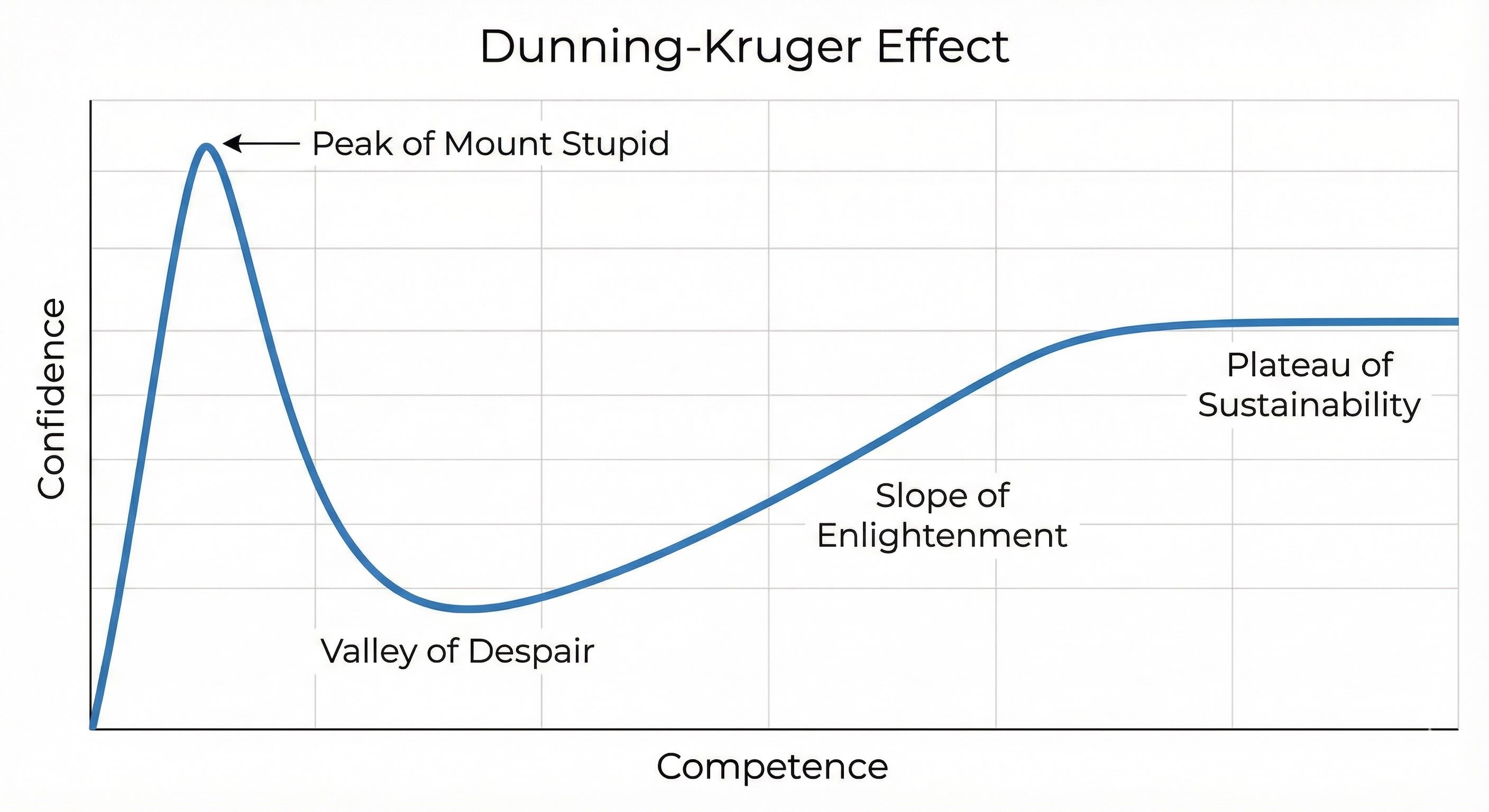
- The Peak of "Mount Stupid": This is the initial phase where a beginner learns a little bit and confidence skyrockets to 100%. They know just enough to think they know everything.
- The Valley of Despair: As they learn more, they realize how complex the field actually is. Confidence crashes. This is a painful but necessary step toward true expertise.
- The Slope of Enlightenment: With continued learning, competence grows, and confidence slowly rebuilds—this time based on reality, not ignorance.
The "Double Curse": Why We Can't See Our Flaws
The core of the Dunning-Kruger effect lies in what the researchers termed a "double curse." For any given skill, a person needs a certain level of competence not only to perform well but also to accurately evaluate their own performance. In other words, the skills required to be good at something are the very same skills needed to recognize you are bad at it.
A beginner learning a new language might string together a few words and feel a surge of confidence, unaware of the complex grammar they are missing. Their lack of knowledge prevents them from seeing the full scope of the skill. This is a deficit in metacognition—the ability to think about one's own thinking.
Real-Life Examples of the Effect
You can see this cognitive bias everywhere in daily life, not just in bank robberies:
- Driving: Surveys consistently show that 80-90% of drivers rate themselves as "above average," which is statistically impossible.
- Workplace: The least competent employees often rate their performance much higher than their supervisors do, while top performers often undervalue their contributions.
- Politics & Science: People with the least knowledge about complex topics (like economics or climate science) often hold the most extreme and confident opinions.
A Toolkit for Gaining Self-Awareness
The good news is that the Dunning-Kruger effect is not a life sentence. It is a product of ignorance, not stupidity. Here is how to fight it:
- Seek and Embrace Constructive Feedback. Actively ask trusted mentors for honest criticism. Don't just listen; ask, "What could I have done better?"
- Keep Learning. The more you learn about a subject, the more you appreciate its complexity. This naturally fosters intellectual humility.
- Challenge Yourself. Step outside your comfort zone. Trying, failing, and analyzing that failure is a potent learning experience.
- Question Your Certainty. Before stating an opinion, ask yourself: "What evidence is my belief based on? Could I be wrong?"
- Take an Objective Test. Sometimes, the most direct way to gauge your knowledge is through a formal assessment. Take our Dunning-Kruger Effect Test now to see where you really stand.
Final Thoughts
The Dunning-Kruger effect reveals that confidence is often a poor indicator of ability. But it also offers hope: the path to wisdom is paved with humility. The goal is not to know everything, but to cultivate the self-awareness to know what you don't know.