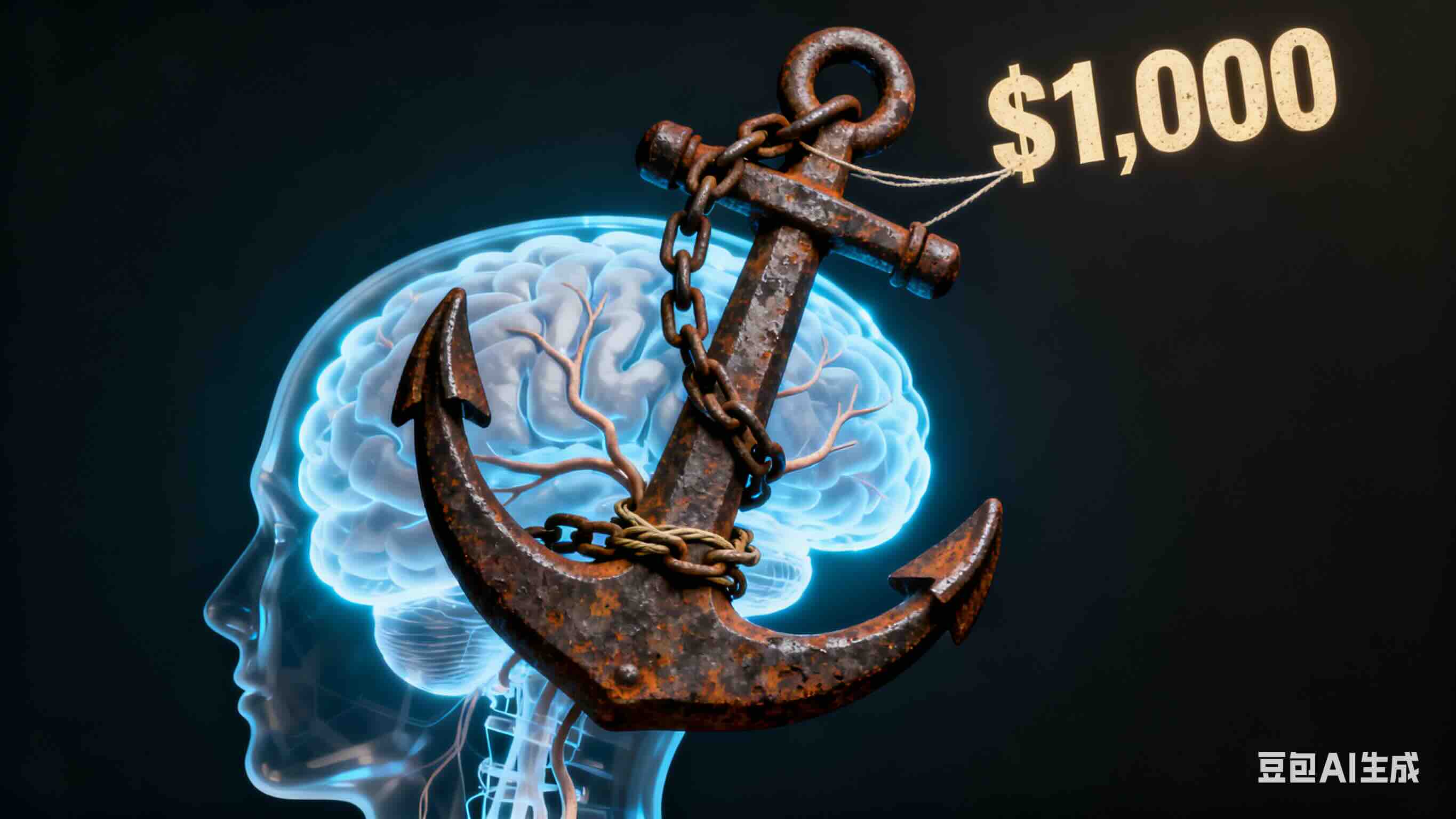
Imagine you walk into a high-end boutique and see a leather jacket with a price tag of $2,000. "That's absurdly expensive," you think. A week later, you're shopping online and see the same jacket on sale for $700. Suddenly, it feels like the bargain of a lifetime. But is it? Or has your perception of its value been hijacked?
You've just been hit by the **anchoring effect**, a powerful cognitive bias that causes us to rely too heavily on the first piece of information we receive (the "anchor") when making decisions. Once that anchor is set, our brain subconsciously adjusts all subsequent judgments relative to that starting point, often with irrational and costly consequences.
The anchoring effect influences everything from the price you're willing to pay for a car to the salary you negotiate for a new job. This guide will explore how this mental shortcut hijacks our thinking and, more importantly, learn practical strategies to lift the anchor and reclaim your rational mind.
How Anchoring Hijacks Your Brain
The anchoring effect was famously demonstrated by psychologists Daniel Kahneman and Amos Tversky. In their experiment, they spun a wheel of fortune rigged to land on 10 or 65. They then asked participants to estimate the percentage of African nations in the UN. The group that saw the number 10 guessed, on average, 25%. The group that saw 65 guessed 45%. A completely random number had profoundly skewed their estimates.
This works because of a mental process called "anchor and adjust." We latch onto the first number and make insufficient adjustments from there. If a car salesman starts at $30,000 (the anchor), you might negotiate down to $27,000 and feel great. But if he had started at $26,000, you might have ended up at $24,000. The starting point frames the entire negotiation.
Where You'll See Anchoring in the Wild
This isn't just a lab experiment; it's a tool used constantly in the real world.
| Scenario | The Anchor | The Psychological Effect |
|---|---|---|
| Retail Shopping | A high, crossed-out "original price." | Makes the sale price seem like a significant bargain. |
| Negotiations | The first offer made (e.g., salary, house price). | Frames the entire conversation and pulls the final number closer to itself. |
| Restaurant Menus | A very expensive "decoy" dish at the top. | Makes the other dishes look reasonably priced in comparison. |
| Purchase Limits | Signs like "Limit 12 per customer." | Anchors you to a higher quantity, making you more likely to buy more. |
Your Toolkit for Resisting the Anchor
While the anchoring effect is powerful, you are not defenseless. With awareness and the right strategies, you can learn to mitigate its influence.
- Increase Your Awareness. The first step is to simply know that the anchoring effect exists. When you enter a negotiation or evaluate a price, consciously identify the anchor. Just acknowledging it can help to reduce its power.
- Make the First Offer (When Prepared). In a negotiation, the power to set the anchor is a huge advantage. If you have done your research, making a confident and well-reasoned first offer can frame the entire negotiation in your favor.
- Actively Challenge the Anchor. If someone else sets the anchor, don't simply adjust from it. Question it. Ask, "How did you arrive at that number?" This can help to dislodge the anchor before it takes firm hold.
- Slow Down and Do Your Own Research. Anchoring has the most power when we think quickly. Before making any significant decision, give yourself time. Ignore the initial number and conduct your own independent research to determine a fair value.
- Test Your Own Susceptibility. Curious about how easily an anchor can sway your own judgment? Taking a practical test can be an illuminating experience. Try our Anchoring Effect Test to see it in action for yourself.
Final Thoughts: The Freedom to Think for Yourself
The anchoring effect is a testament to the power of suggestion and the brain's relentless pursuit of efficiency. It shows that our judgment can be hijacked by something as simple as a random number. But awareness is the key to liberation. By understanding how anchoring works, learning to identify the anchors in our environment, and consciously choosing to challenge them, we can break free from their invisible chains. In a world full of anchors, learning to think for yourself is a superpower.